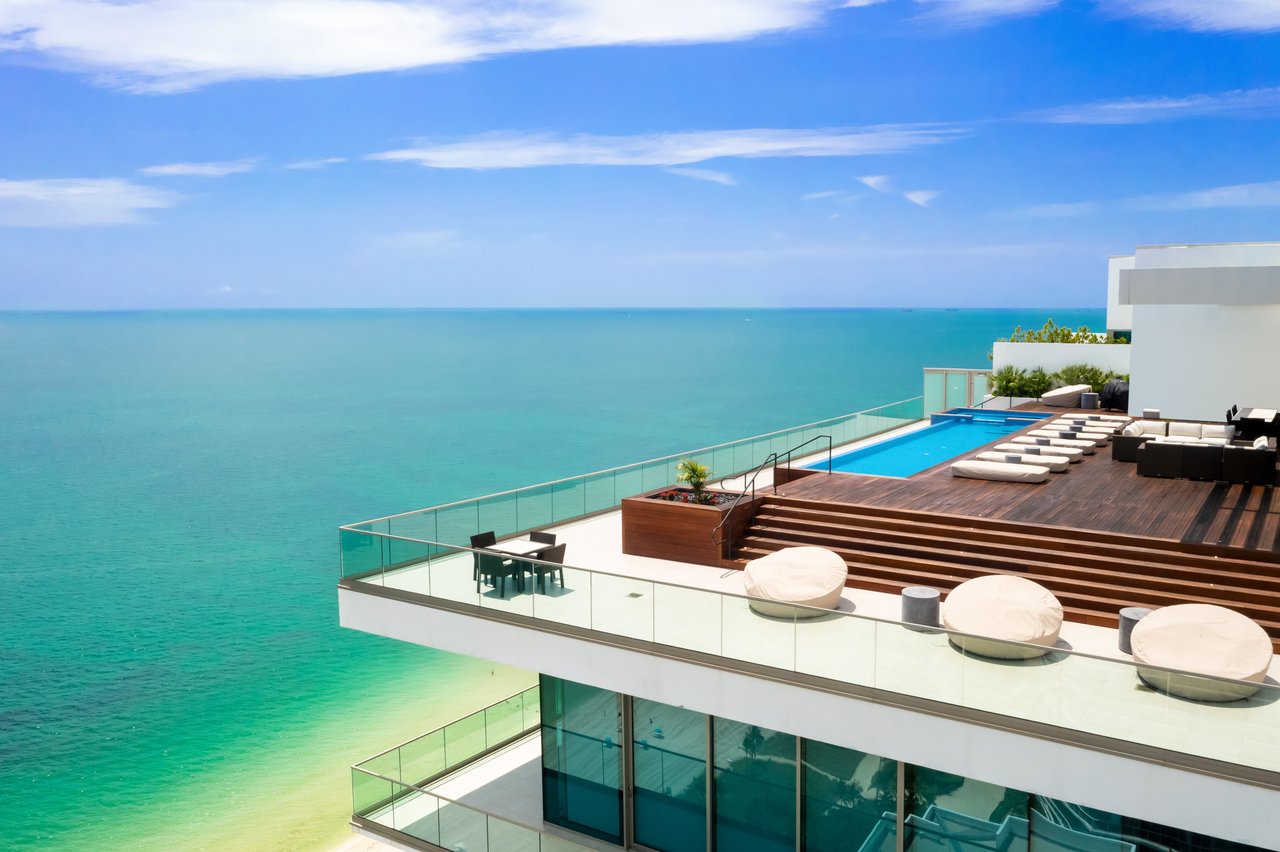
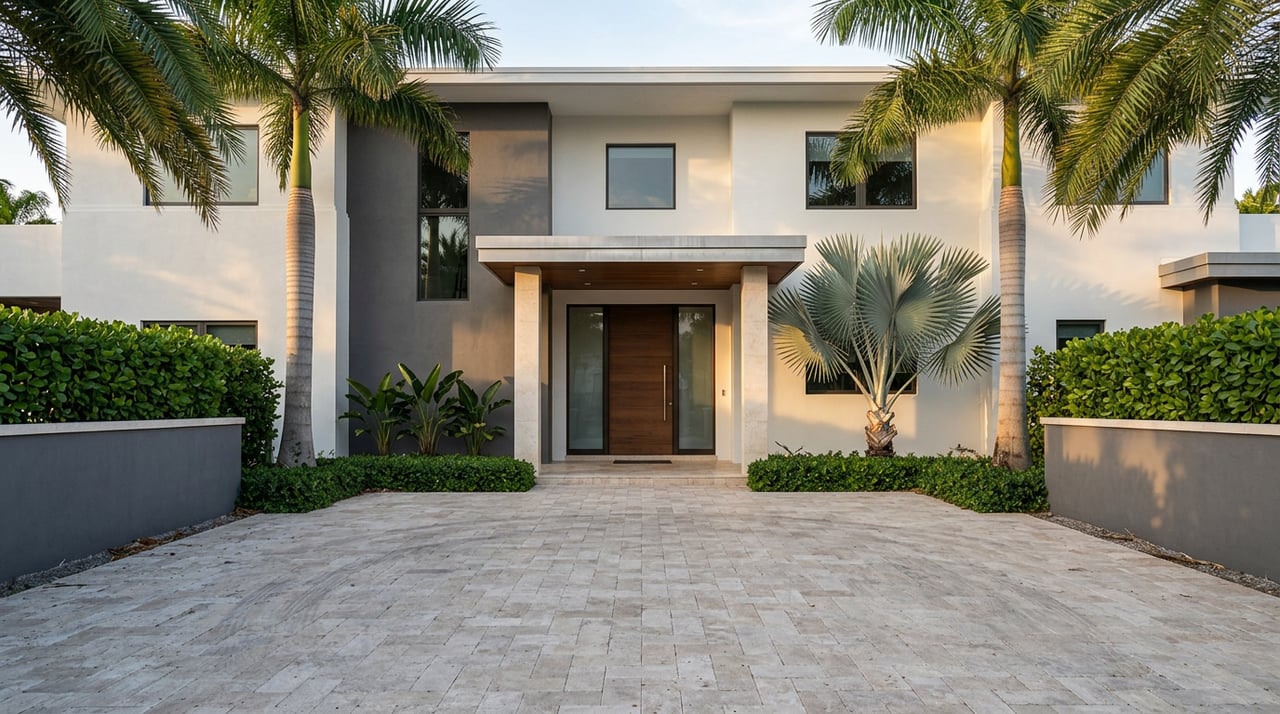
Two buyers can write offers on Boca Raton homes listed at exactly $2.4 million this month, in two different gated communities a few minutes apart, and walk away from the closing table having paid meaningfully different totals for the same size check. One pays $2.4 million plus the ordinary costs of closing. The other pays $2.4 million plus a country club fee that never appears on the listing sheet, priced anywhere from the mid five figures to well past $400,000 depending on which gate they drove through.
That gap is not a rounding error. It is the single most common thing that catches relocating buyers off guard once they are already under contract in a West Boca club community, and it is just as often missed by sellers pricing a home as if the club fee doesn't exist. The mechanism behind it is simple once you see it: some Boca Raton clubs require membership as a condition of buying the home, and some don't require it at all. Getting that backwards, or assuming every gated community works the same way, is how a buyer ends up surprised at the closing table or a seller ends up sitting on a listing for 90 days wondering why the offers aren't coming.
Why the Same Address Type Can Mean Two Different Purchases
Boca Raton's country club market runs on at least three distinct models, and a buyer touring three communities in one afternoon can walk through all of them without anyone pointing out the difference.
In the first model, membership is mandatory and bundled into ownership. Buy the house, and you are automatically a member, whether you golf or not. In the second, membership is entirely optional and separate from the deed, decided through nomination and board approval rather than a closing document. In the third, there is no traditional initiation fee at all, and club-style amenities are funded through the HOA instead. The Oaks, in West Boca, is the community most often cited as running on that third model, with no separate membership initiation fee layered on top of the home price.
None of the three models is better than the others. They serve different buyers. But they are not interchangeable, and the only way to know which one applies to a specific address is to ask before writing the offer, not after.
The Clubs Where Membership Comes With the Deed
Several of Boca's best-known clubs fall squarely into the mandatory category. Woodfield Country Club states plainly on its own site that membership is mandatory, meaning every home buyer in the community becomes a club member as a condition of ownership. Woodfield's standard equity tier is reported at a $38,000 equity contribution plus a $60,000 non-refundable initiation fee, with annual dues around $18,234. Full equity membership runs higher, though published totals for that tier disagree by six figures depending on which guide you read, which is itself worth sitting with for a moment. Two 2026 sources describing the same Woodfield full equity tier land on totals as far apart as roughly $125,000 and $225,000. That is not a small discrepancy in a market where buyers are comparing offers down to the thousands.
Bocaire Country Club is similarly mandatory for its roughly 236 custom homes, with a reported $200,000 non-refundable initiation fee and recreational facility dues near $37,834 a year. Because Bocaire operates as a combined club and property owners association, buyers there also avoid the separate 7 percent Florida sales tax that applies at clubs where membership and the HOA are structured independently. Boca Woods Country Club runs a mandatory golf-only structure reported at roughly $75,000 in initiation plus a $20,000 equity bond, for a total near $95,000.
St. Andrews Country Club is the clearest example of why a buyer should never treat a published fee schedule as final. Golf membership there is mandatory for every resident, but reported figures for the full membership fee range from roughly $200,000 in older citations to $275,000, to $400,000, to $450,000 in the most recent 2026 sources, plus a separate property owners' contribution due at closing. Multiple guides published within months of each other, all claiming to reflect 2026 pricing, disagree by well over $200,000 on the same club. That volatility is the point. Confirm the current number with the membership office directly before an offer goes in, not from any secondhand guide, including this one.
Here is how the mandatory-membership clubs compare on the figures with the clearest documentation:
| Club | Membership required to buy? | Reported entry cost | Refundable portion |
|---|---|---|---|
| Woodfield Country Club | Yes, for every buyer | Standard tier: $60,000 initiation + $38,000 equity | Equity contribution only |
| Bocaire Country Club | Yes, golf mandatory | $200,000 non-refundable initiation | None |
| Boca Woods Country Club | Yes, golf mandatory | Roughly $75,000 initiation + $20,000 equity bond | Equity bond only |
| St. Andrews Country Club | Yes, golf equity mandatory | Reported $200,000 to $450,000 depending on source and date | Varies by report |
The One Address Where Membership Is Optional
Then there is Royal Palm Yacht & Country Club, and it inverts the assumption entirely. Royal Palm is the most exclusive residential address in Boca Raton, a 450 acre enclave on the Intracoastal Waterway that Forbes has recognized among the most expensive gated communities in the country. Homes there range from about $2 million to more than $30 million, with recent sales averaging around $11 million. And yet homeownership at Royal Palm carries no obligation to join the club at all.
Membership and ownership are two entirely separate transactions. To join the club, a prospective member needs nomination by two existing members and approval from the board. As the club's own site puts it, there are no residency requirements to be considered for membership, and residency is no guarantee of acceptance. A buyer can close on a $15 million estate behind Royal Palm's gates, live there for years, and never set foot in the clubhouse as a member, or apply, wait, and still not get in. It is the exact opposite risk profile from Woodfield or St. Andrews, where membership is guaranteed the moment the deed transfers. Homeowners there also pay a separate property owners' association fee, reported at roughly $4,150 per lot annually, regardless of whether they ever join the club itself.
Refundable Versus Non-Refundable Is the Number That Actually Matters
Even within the mandatory clubs, the headline total is less important than how it splits. An equity contribution is typically refundable when a member resigns or sells, the way Woodfield's $38,000 standard equity or Boca Woods' $20,000 bond works. An initiation fee is generally not refundable at all, the way Bocaire's full $200,000 works or the non-refundable portion at Woodfield and Boca Woods does.
That split changes the real economics of ownership in a way the total dollar figure hides. A club with a $95,000 fee that is 80 percent refundable is a very different long-term commitment than a club with a $95,000 fee that is entirely non-refundable, even though both list the same number on a fee sheet. When a seller in one of these communities is pricing a home, or a buyer is comparing two similarly priced options, the refundable share is worth asking about before the equity contribution or the total headline number.
The Clock Nobody Puts in the Contract
Club membership approval also runs on its own timeline, and that timeline does not always cooperate with a closing date. Broken Sound Club illustrates this well. The club recently introduced a Club Course Member in Waiting program designed to give Sports Members already on the golf waitlist limited interim access while they wait for a full Club Course Golf membership to open up. Once a spot becomes available, the member receives written notice and has five business days to accept it or lose their place and return to Sports Membership status. That is a real deadline with real consequences, and it is the kind of detail that only shows up if someone is actively tracking a club's current bylaws rather than working from a fee sheet printed a year ago.
At nomination-based clubs like Royal Palm, the timeline risk runs even further. Because membership is discretionary and separate from the purchase, a buyer who assumes they will simply join after closing may find the process takes months, requires sponsors they don't yet have, or does not resolve the way they expected. None of this makes the underlying real estate a bad decision. It makes it a decision that deserves the same diligence as the home itself.
What to Confirm Before You Write the Offer
- Whether membership is mandatory, optional, or handled entirely through the HOA, and get that answer in writing from the club, not from a listing description
- Whether the fee is split between a refundable equity contribution and a non-refundable initiation charge, since that split changes the real cost far more than the headline total
- Whether an approval process, nomination requirement, or waitlist applies, and how long it typically takes, so the timeline is built into the purchase contract rather than discovered after closing
- Whether the initiation fee is expected to be paid by the buyer, the seller, or split, since that is negotiable and should be addressed directly in the offer
A Few Direct Questions
Can a country club initiation fee be rolled into a mortgage? Generally no. Initiation fees are typically not mortgageable unless a buyer arranges separate financing through the club or a private lender, so most buyers plan to cover that portion in cash.
If I buy in a mandatory-membership club, is my membership guaranteed? In communities like Woodfield, Bocaire, and St. Andrews, membership is a condition of the deed, so it follows automatically with ownership. The discretionary approval risk sits with nomination-based clubs like Royal Palm, where membership is a separate club decision from the real estate transaction.
Who typically pays the initiation fee, buyer or seller? It varies by transaction and is negotiable. Some purchase agreements have the buyer pay it directly to the club, others have it split or credited by the seller, but either way it should be spelled out in writing before the contract is signed.
Country club real estate in Boca Raton rewards buyers and sellers who ask the second question, not just the first one. If you are comparing homes across Woodfield, St. Andrews, Bocaire, Broken Sound, Royal Palm, or any of the other communities that make up this market, the Matt & Nick Team can pull the current membership structure, the refundable split, and the approval timeline before you tour, so the number you fall in love with is the number you actually pay.